New weapons against cancer: How combination immunotherapies and targeted therapies improve survival rates
- Scientific news
- Medicine

Targeted therapies and combination immunotherapies are the latest advances in cancer treatment. For instance, a new molecularly targeted therapy offers hope for the first time in the treatment of pancreatic cancer. Furthermore, in immunotherapies, dual checkpoint blockade can improve survival rates for cancers that were long considered hopeless – such as metastatic melanoma – to such an extent that 43 per cent of patients are still alive after 10 years. Which combinations work, how they work, and how their effectiveness can be enhanced as a result – these are the key topics at the annual conference of the German, Austrian and Swiss Society for Haematology and Medical Oncology, which is taking place from 9 to 12 October at the Austria Center Vienna.
“With the many new developments in targeted therapies, immunotherapies and combination therapies, we now have a wide range of effective treatment options available for various types of cancer. Much of this is down to the fact that we are better able to identify the unique characteristics of a tumor and target it specifically. It is important to remember that any tumor that can be prevented is better than one that can be treated effectively. Screening and prevention therefore remain absolutely crucial,” emphasizes Prof. Dr Maike de Wit, Head of the Vivantes Clinics for Haematology, Oncology and Palliative Care in Neukölln and Schöneberg, Berlin, and one of the two conference chairs at the Annual Meeting of the German, Austrian and Swiss Society for Haematology and Medical Oncology.
Targeted therapy: Tackling the problem within the cell at the level of the gene mutation
“Targeted therapies tackle the problem within the cell; in these cases, there is an identified mutation that causes tumor growth. We can therefore specifically target this mutation using small molecules that we deliver into the cell. We look not only at the affected organ – such as the lung – but also at the tumor’s comprehensive molecular profile in order to identify any mutations. EGFR, KRAS and ALK alterations are the most important so-called ‘driver mutations’ for the tumor in non-small cell lung cancer,” explains de Wit. “We can treat ALK-positive lung tumors – which frequently also cause brain metastases – so effectively with modern ALK inhibitors such as alectinib or lorlatinib that we enable patients to achieve very long survival,” emphasizes de Wit.
Molecularly targeted therapy: a breakthrough in pancreatic cancer
Another revolutionary breakthrough in the molecular genetic fight against cancer has recently been achieved in the treatment of pancreatic adenocarcinoma, the most common form of pancreatic cancer. In this form of cancer, 90 to 95 per cent of cancer mutations occur in the KRAS gene. This mutation keeps the cancer cell in a permanent growth state and drives tumor development. For decades, the RAS signalling pathway was considered untargetable by drugs because the protein has no obvious binding site for them. “However, the development of a new RAS inhibitor has now marked a major step forward. The active substance, Daraxonrasib, targets various RAS mutations; it is currently being extensively investigated for use in earlier stages of metastatic pancreatic cancer and is on the verge of being approved for this indication,” said de Wit. The drug has already doubled survival rates. Although the active substance cannot yet cure pancreatic cancer, it can significantly improve survival.
The principle behind immunotherapies – antigens that bind to cells
Unlike targeted molecular therapies, which act within the cell, immunotherapies operate on a different principle. “With immunotherapies, we can target surface antigens – that is, markers displayed on the surface of cells – using antibodies. These genetically engineered monoclonal antibodies bind to the cell surface and act from there,” explains de Wit.
Combined immunotherapies in a single drug
As monoclonal antibodies, which can bind to the outside of a cell, can also be loaded with other substances, they are frequently used in combination therapies. As with antibody-drug conjugates (ADCs), an additional active substance intended to target the cancer cell is bound to an antibody. This active substance may be a chemotherapeutic agent, a radioactive substance or another active ingredient. The key point here is that a combination of immunotherapy and another active substance is administered in a single drug. “In the case of prostate cancer, for example, this second active substance is a radioactive particle that binds to the prostate-specific membrane antigen (PSMA) via the antibody, thereby delivering the radiation directly to the cancer cells. In this way, the radiation can be used to kill almost exclusively the diseased cells in a targeted manner,” emphasizes de Wit.
Combination immunotherapy with checkpoint inhibitors
“Another form of combination immunotherapy involves administering an immunotherapy, such as checkpoint inhibitors, alongside another treatment, such as chemotherapy, either simultaneously or at different times,” explained the oncologist.
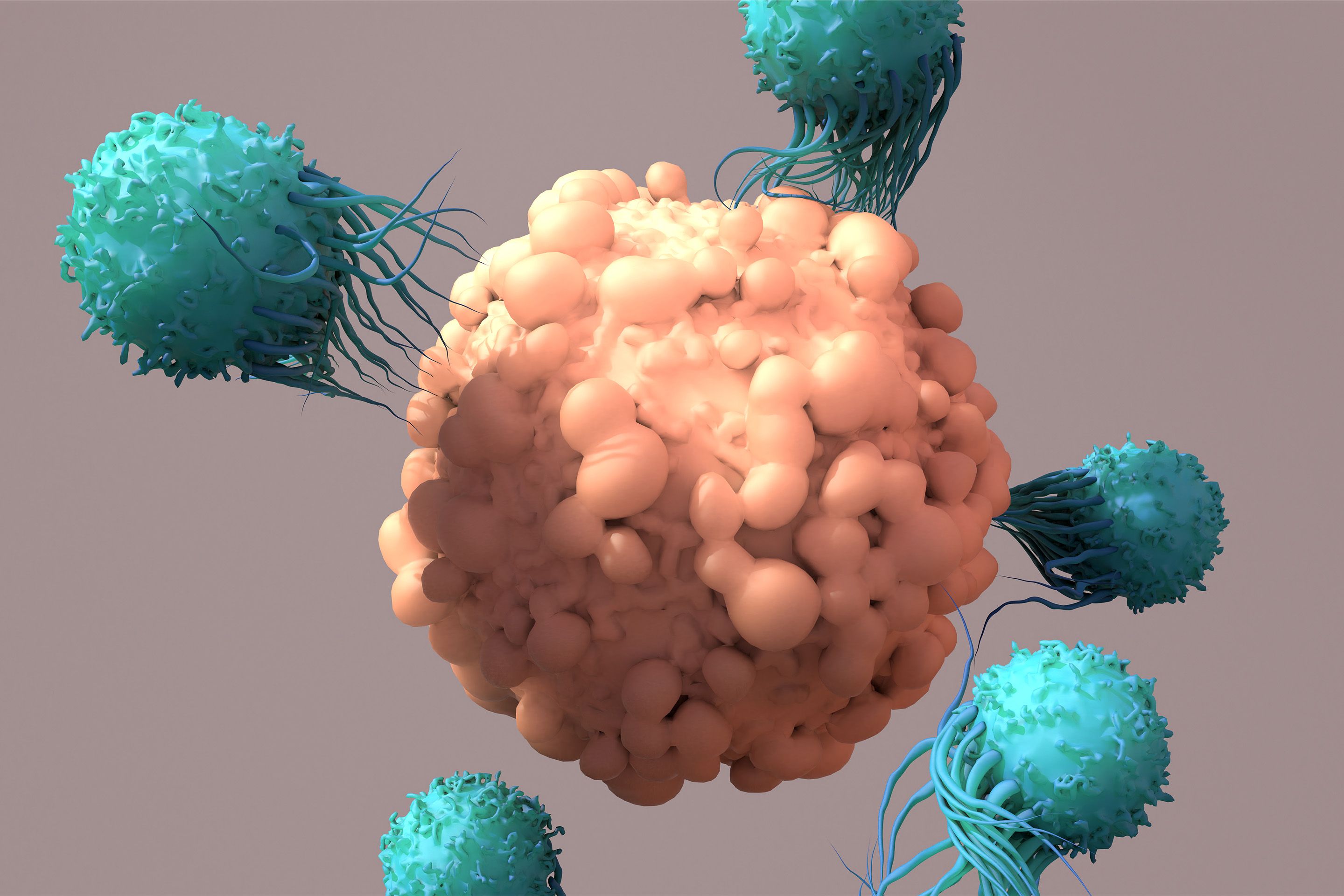
“To put it simply, you can imagine it like this: a person’s active, immunocompetent T-cells constantly check whether the cells in the body are healthy and desirable cells that are part of the body’s normal functioning. If, in response to their query (PD-1 receptor), they do not receive the expected ‘welcome code’ (PD-L1 receptor) in return, the immune system attacks these unmasked cells,” explains de Wit. The commonly used checkpoint inhibitors – PD-1 and PD-L1 inhibitors – remove the tumor cell’s disguise (PD-1 receptor) as a healthy, body-own cell.
The rationale behind a specific sequence of treatment is to activate the immune system as effectively as possible against the tumor. Chemotherapy or radiotherapy destroys tumor cells. In the process, tumor antigens are released, creating an inflammatory – in other words, a ‘hot’ – tumor microenvironment. Subsequently, checkpoint inhibition can be particularly effective because the immune system is then better able to recognize the tumor cells.
Advantages of the combination: faster and longer-lasting efficacy
The advantages of combination therapy are that chemotherapy or radiotherapy takes effect more quickly than immunotherapy; furthermore, it creates a tumor microenvironment that is particularly conducive to immunotherapy, whilst the immunotherapy then ensures that the body’s long-term immune response is maintained. This long-term effect prevents any remaining cells that were not destroyed by chemotherapy or radiotherapy from surviving and starting to grow again. Furthermore, the combination usually means that fewer cycles of chemotherapy are required.
Dual checkpoint blockade – a combination of two immunotherapies
With dual checkpoint blockade, existing treatments, such as chemotherapy and radiotherapy, are combined not just with one checkpoint inhibitor, but with two. ‘We often combine a CTLA-4 inhibitor, such as ipilimumab, with a PD-1 inhibitor such as nivolumab. As the immune system has several ‘brakes’ designed to prevent T-cells from attacking healthy tissue, by combining two checkpoint inhibitors we simultaneously disable two of these ‘brakes’ that tumor cells use to hide from the immune system. “This allows more tumor cells to be recognized and destroyed,” emphasizes de Wit. For patients with metastatic melanoma, for whom there was previously virtually no treatment available, dual checkpoint blockade has now significantly improved their life expectancy from a maximum of one year to several years. “Whilst single-agent immunotherapy with ipilimumab achieves an overall survival of 20 months and nivolumab 36 months, the combination of both drugs increases overall survival to 72 months. The long-term data are also particularly impressive here, showing that 43 per cent of patients receiving the combination therapy are still alive after 10 years. Before the introduction of checkpoint inhibitors, this figure was 6 to 12 months,” said de Wit. Similar effects are also seen in other tumors, such as renal cell carcinoma.
Success against cancer despite the potential side effect of autoimmune diseases
As the use of checkpoint inhibitors can also cause the body’s own cells to be attacked if they do not recognize the ‘welcome code’, cells that have been altered by other causes – for example, following infections – are also targeted as a side effect. These autoimmune side effects are exacerbated by dual checkpoint blockade. Consequently, unfortunately, 5 to 10 per cent of patients have to discontinue this treatment early. “However, studies show that when immunotherapy is discontinued due to autoimmune side effects, the immune cells have usually been activated to a great extent, and so the tumor often remains under control for a long time nonetheless. This is very reassuring for patients and encourages us to continue relying on checkpoint blockades in both single and dual forms,” said de Wit.
About IAKW-AG, DGHO, OeGHO, SGMO and SGH
IAKW-AG (Internationales Amtssitz- und Konferenzzentrum Wien, Aktiengesellschaft) is responsible for the maintenance of the Vienna International Centre (VIC) and the operation of the Austria Center Vienna. With 21 halls, 134 meeting rooms and around 26,000 m² of exhibition space, the Austria Center Vienna is Austria’s largest conference centre and ranks among the leading players in the international conference industry. The annual conference of the German Society for Haematology and Medical Oncology (DGHO), the Austrian Society for Haematology and Medical Oncology (OeGHO), the Swiss Society for Medical Oncology (SGMO) and the Swiss Society for Haematology (SGH) is the largest congress on blood and cancer diseases in the German-speaking world.
Contact

You might also be interested in
From T-cell engagers to in vivo cell therapy and vaccination: The next generation of cancer treatment
Cancer remains the second leading cause...

From fatal to treatable: new immunotherapies and mRNA vaccines are revolutionizing melanoma treatment
Thanks to innovative immunotherapy, the survival...

Well-intentioned, but dangerous in wrong doses: dietary supplements as a potential health risk during cancer treatment
Over the course of a lifetime,...